Typically, I would suggest that good sustainable development practice should be something that begins with strategy: defined objectives, structured delivery, and clearly articulated impact pathways. However, my experience working with refugee communities suggests something more nuanced. While strategy matters, the most durable and meaningful outcomes in this space have emerged through long-term engagement, responsiveness, and a commitment to relationships over rigid design.
This work began in 2012 through DMU’s Square Mile initiative in Leicester. As one of the UK’s most diverse cities, Leicester provided a context in which issues of migration and displacement were not abstract policy concerns, but part of everyday lived experience. Refugees were not an initial target group within the project, but their presence shaped the direction of the work. A key principle of effective sustainable development practice – working with communities as they are, rather than as they are imagined – became embedded early on.
By 2015, this approach had evolved into DMU Local, alongside an institutional emphasis on internationalisation through DMU Global. With modest philanthropic support, I was able to extend this model into Berlin. The intention was not to replicate a fixed intervention, but to transfer an approach: one grounded in trust, reciprocity, and consistent presence. This reflects a core tenet of the idea of sustainable development – the importance of context-sensitive, relational models that can adapt across settings rather than impose uniform solutions.
The timing of the project’s expansion coincided with the 2015 refugee arrivals into Germany, catalysed in part by the political stance articulated by Angela Merkel in her statement “Wir schaffen das.” This moment tested the flexibility of our approach. Planned activities like skills workshops, educational programmes and cultural engagement, were rapidly overtaken by more humanitarian needs. In response, the work shifted accordingly: providing food, sorting clothing and supporting new arrivals.
This pivot is instructive. It demonstrates the value of adaptive delivery models that can respond to rapidly changing conditions without losing their underlying principles. Rather than viewing this as a deviation from planned outcomes, it became a form of practice-based learning, highlighting that resilience, both in communities and in programmes, depends on flexibility and trust.
Student engagement has been central throughout. Importantly, their involvement has not followed a traditional “service delivery” model. Instead, it has been characterised by co-presence and mutual exchange. This aligns closely with participatory approaches within sustainable development, where knowledge, experience, and value are co-produced rather than transferred in a one-directional manner.
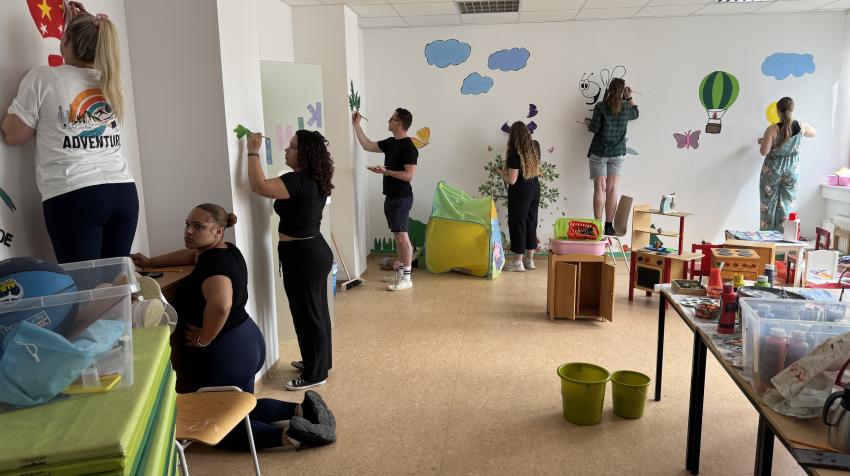
Over time, this work has developed into the hugely popular Project Atefa programme at DMU, shaped by the lived experience of a refugee academic and grounded in a commitment to recognising the capabilities and contributions of displaced communities. The demographic focus has shifted in line with global events – from Syrian to Iraqi, Afghan, and Ukrainian communities – demonstrating how local practice is often a reflection of wider geopolitical dynamics. This reinforces another key principle: sustainable development work is rarely static and must remain responsive to changing global and local contexts. The photo above shows students decorating a children’s playroom at a refugee shelter in Pankow, Berlin,
The most significant insight from this body of work is that sustainability is not simply about longevity of programmes, but about the depth and quality of relationships that underpin them. Ten years of consistent engagement have created a network of partners and a body of practice that is both resilient and adaptable.
If there is a transferable lesson, it is this: impactful sustainable development practice is not solely the product of careful design, but of sustained commitment, openness to uncertainty, and the ability to work relationally across contexts. The endurance of this the result of continued investment of university students, colleagues, and community partners in Leicester and Berlin who recognise its value and choose to sustain it.
*The plan with this article is a chance to bring those interested up to speed with a brief history of the project and what follows is my opportunity to share more experiences leading the United Nations Academic Impact Chair Hub for Sustainable Development Goal 11. If anyone wants to learn more about Project Atefa, please email me via: mcharlton@dmu.ac.ukPotted Timeline:
Timeline in Press Releases:
2016: Leicester project evolves to Berlin
2017: DMU Alumni join project as refugee engagement inspire students
2018: Students work on United Nations’ Together campaign in Leicester and Berlin.
2019: DMU students in Berlin inspire European volunteer project
2020: Lockdown followed by personal illness paused the project in Berlin
2023: Project strengthens UN relationship as student create Project Atefa
2025: Students from De Montfort University mark World Refugee Day in Leicester and Berlin
2026: Two Berlin projects scheduled this year, Leicester under way
*The plan with this article is a chance to bring those interested up to speed with a brief history of the project and what follows is my opportunity to share more experiences leading the United Nations Academic Impact Chair Hub for Sustainable Development Goal 11. If anyone wants to learn more about Project Atefa, please email me via: mcharlton@dmu.ac.uk


Leave a comment