There was no grand strategy behind my work with refugee communities, no neat research proposal, no carefully plotted trajectory. It began, as many things in universities do, with something far less deliberate: proximity, curiosity, and a series of coincidences that, in hindsight, feel anything but accidental.
In 2012, I was working across Leicester through DMU’s social science outreach initiative called DMU Square Mile. Leicester is often described as one of Britain’s most multicultural cities and while refugees were not part of the original design of the work, thankfully, their presence was inescapable.
By 2015, that work had evolved into DMU Local, alongside a growing institutional push toward international student mobility through DMU Global. Around the same time, I was given a modest pot of philanthropic funding to trial projects in Berlin. The opportunity came about in a way that now feels almost absurd: someone had noticed me on Twitter (now rebranded as X) chatting in German about football with fellow Hertha BSC supporters.
When asked what I would do with the funding, my answer was instinctive rather than strategic: Just what I was already doing in Leicester. It was a simple proposition, grounded in relationships I already had in Charlottenburg and a belief that community engagement travels better through people than through policy frameworks.
History intervenes.
In August 2015, Angela Merkel said a phrase that would come to define a political era: “Wir schaffen das”, “we can do this”. It was a statement of intent, signalling Germany’s willingness to welcome more than a million refugees, many fleeing the war in Syria. Those three words reverberated far beyond Germany’s borders. For some, they represented a high-water mark of humanitarian leadership; for others, they became shorthand for political overreach and the perceived fragility of European borders.
The rhetoric quickly translated into something more immediate and tangible. Plans shifted. What had begun as relatively conventional outreach plans like IT skills workshops, language learning, arts engagement, gave way to the practicalities of arrival: distributing food, sorting clothing, cooking meals, offering presence rather than programmes.
DMU students responded not with hesitation but with energy. The connections formed, particularly with Syrian refugees, were marked by a kind of immediacy that is difficult to replicate in more structured settings. But there was little sense of “service delivery”, it was more of shared human endeavour.
A decade on, the phrase “Wir schaffen das” still hangs in the air and what began as a set of refugee outreach activities have since become Project Atefa, named in recognition of a refugee academic whose experience came to symbolise the human potential of people too often overlooked in displacement narratives.
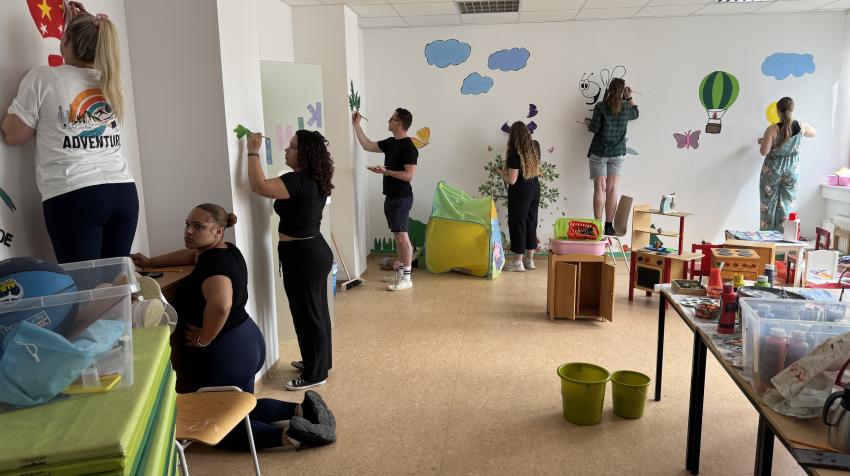
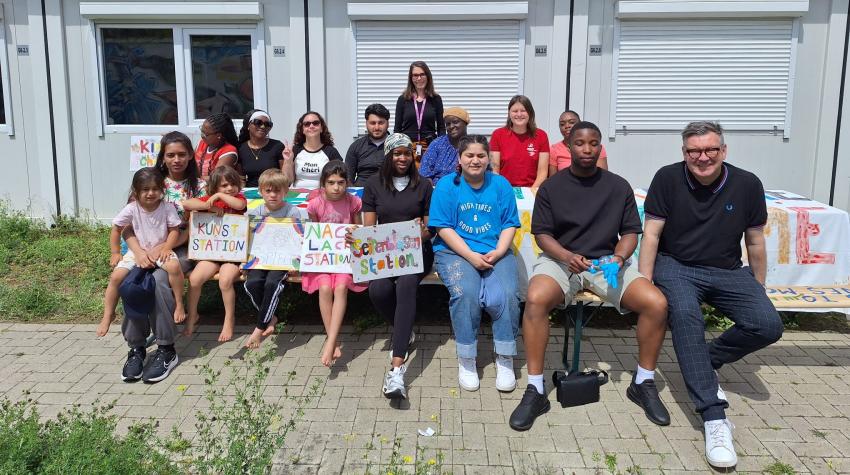
The demographics of the work have shifted with the fault lines of global conflict. Where once the majority were Syrian, the years have brought Iraqi, Afghan and, more recently, Ukrainian communities into focus. The pattern is unmistakable: our local engagements seem to map, imperfectly but persistently, the geopolitical crises elsewhere. Students embrace projects with a passion, like painting a refugee centre’s play room (see photo at the top) to helping out for refugee centre community open days (see photo above).
If there is an interesting lesson in all of this, it is that meaningful engagement often emerges not from institutional design but from the willingness to follow where circumstances, relationships and coincidences lead.
Ten years on, the work endures not because it was carefully engineered, but because people – staff, students, and community partners in both Leicester and Berlin, refused to let it end.
Potted Timeline:
2016: Leicester evolves to Berlin
2017: DMU Alumni join project as refugee engagement inspire students
2018: Students work on United Nations’ Together campaign in Leicester and Berlin.
2019: DMU students in Berlin inspire European volunteer project
2020: Lockdown followed by personal illness paused the project in Berlin
2023: Project strengthens UN relationship as student create Project Atefa
2025: Students from De Montfort University mark World Refugee Day in Leicester and Berlin
2026: Two Berlin projects scheduled this year, Leicester under way
*The plan with this article is a chance to bring those interested up to speed with a brief history of the project and what follows is my opportunity to share more experiences leading the United Nations Academic Impact Chair Hub for Sustainable Development Goal 11. If anyone wants to learn more about Project Atefa, please email me via: mcharlton@dmu.ac.uk
 Sustainability Field Notes
Leave a comment