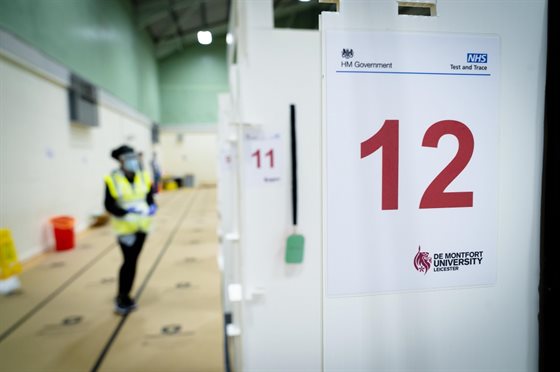
Who remembers the Summer of 2020? As the rest of the country began to emerge from the first wave of the pandemic, with pubs reopening, hairdressers welcoming back clients, and a sense of cautious optimism returning, Leicester faced a very different reality.
We became the first city in the UK to be placed under local lockdown. While the nation celebrated new freedoms on July 4, Leicester’s residents and businesses were asked to stay shut and stay in, as a sharp rise in Covid-19 cases gripped the city.
Personally, I was a few months into a project I was leading about how Leicester and Leicestershire, United Kingdom, could ‘Build Back Better’ following the pandemic, commissioned by the City Mayor’s Office. More than 70 researchers, 60 community groups, representatives from 40 businesses, senior council and local authority officials took part and a public consultation via the media considered six key areas of recovery: Economy, Environment, Infrastructure, Health and Humanitarian, Community and Future City.
When I started the project in early April, I was unaware Leicester’s lockdown would become the longest and most challenging of anywhere in the country. Nearly 15 months of on-and-off restrictions, curfews, closures, and uncertainty followed. When the Prime Minister finally announced a national roadmap out of lockdown on February 22, 2021 — with the promise of restrictions ending by June 21 — it felt like a light at the end of a very long tunnel.
The statistics that triggered Leicester’s lockdown were stark. In the last week of June 2020, 10% of all Covid-19 cases in England were recorded in our city. On June 29, the Health Secretary confirmed what many had feared: Leicester would not reopen with the rest of England. Shops that had only just reopened on June 15 were ordered to close again from June 30. Bars, restaurants, and hairdressers were told to stay shut.
Testing capacity was ramped up. In nearby Oadby and Wigston, more than 9,000 households were urged to get tested — regardless of whether they showed symptoms. Messages went out through GP texts and door-to-door leaflets.
Two and a half weeks into local lockdown, frustrations began to boil over. Tensions surfaced between local and national leaders. Sir Peter Soulsby, Leicester’s City Mayor, voiced his concerns that key data was being withheld — data that was guiding decisions about the city’s future. He argued that the figures no longer justified locking down the entire Greater Leicester area.
By early August, after four weeks of restrictions, there was finally some relief. Bars, restaurants, cafes, hairdressers, cinemas, museums and places of worship were allowed to reopen. But for leisure centres, gyms, and pools, the wait continued. The city’s most vulnerable residents were still told to shield.
As the summer drew on, Leicester’s restrictions were gradually eased — but never entirely lifted. September 15 brought the reopening of casinos, bowling alleys, skating rinks, and other indoor venues.
But the optimism didn’t last. Like the rest of England, Leicester entered another national lockdown in November as cases rose ahead of Christmas. And again, in January 2021, a more infectious variant and the impact of holiday gatherings pushed the country — and our city — back into lockdown.
Finally, in February 2021, came a roadmap. A plan. A promise of better times. The Prime Minister’s four-step plan offered hope that, by June 21, we might see the full reopening of society. The success of the vaccine rollout had, in his words, “shifted the odds in our favour.”
For Leicester, the journey had been longer and harder than most. The reasons were complex: multi-generational households, the type of work many of our residents do, and long-standing inequalities that Covid so cruelly exposed. As Professor Ivan Browne, our Director of Public Health, reminded us – the virus found fertile ground in the very fabric of our communities.
My ‘Build Back Better’ had the city’s community at its heart. More than 70 DMU researchers, 60 community groups, representatives from 40 businesses, senior council and local authority officials took part and a public consultation via the media considered six key areas of recovery: Economy, Environment, Infrastructure, Health and Humanitarian, Community and Future City drew more than 250 ideas and potential interventions the participants felt needed to be addressed in order to come out of the crisis with a pathway to recover stronger. The Leicester Mercury also supported the project – gathering a further 30 ideas from readers. A focus group of 12 people, representative of small working groups from the key consultations, then crunched the responses into five key recommendations with suggested interventions per theme, reflecting the issues people in the consultations had felt most strongly about. I then published those findings and shared document with the Leicester City Council (LCC) Mayor’s Office. Members of the Local Resilience Forum (LRF) also received the report as a guide to current policy making for the recovery effort for Leicester and Leicestershire. The document, which was also circulated with all participants of the ’Build Back Better’ consultations, presented the opportunity for collaboration across the suggested interventions allowing local authorities, academics, community partners and businesses to work together on the issues outlined.
Some of the ideas were adopted and included in Leicester City Council’s economic recovery plan. All of the ideas made sense. I also wrote a paper on the work with Professor Rachel Granger at DMU called:Redefining city governance: towards rapid-response open planning for Town Planning Review.
Also, for the record, many university staff were doing remarkable things during the pandemic. In fact, I would argue De Montfort University (DMU) played a pivotal role in supporting Leicester’s communities during the COVID‑19 pandemic across multiple fronts. Worthy of note are 200 DMU volunteers who partnered with the charity E2 (Beaumont Leys), delivering over 1,000 hours of service. These volunteers knocked on doors, prepared meals, dispatched emergency food parcels, ran food banks, and provided companionship for isolated elderly residents on one of the city’s poorest estates. Staff and students repurposed university resources—such as laser cutters, sewing machines, and 3D printers—to manufacture hospital scrubs, face masks, scrub bags, and plastic visors. A dedicated packing centre was created which handled and dispatched these PPE items: 4,000+ visors, hundreds of scrubs, and countless masks to Leicester hospitals, care homes, and schools. Hundreds of Nursing and Midwifery students supported frontline NHS teams and Leicester care homes with clinical placements and the Estates and Health & Life Sciences teams donated lab PPE and diagnostic equipment, significantly boosting testing capacity. DMU researchers worked on drug repurposing (with Oxford University) and contributed to global drug testing infrastructure. Virologists advised government guidelines on healthcare uniform laundering to reduce hospital-acquired infections and psychologists conducted early studies into the lockdown’s impact on dietary habits. DMU Works (the careers team) initiated a voluntary placement scheme matching digital-savvy students with 23 local SMEs, helping businesses pivot online through website development, digital marketing, and crisis strategy.
Recently I have been reflecting on those long months of isolation, closures, and loss. The only shaft of light in the darkness of it all was the resilience demonstrated by my adopted home city. Leicester’s people – its businesses, communities, key workers and families – had endured more than most, and it’s here to tell the story.
I have recently returned to the “Build Back Better” idea which was a key promise from the UK government – a slogan that captured hopes of addressing deep-rooted inequalities, creating good jobs, improving public services, and making society more resilient after Covid-19. In reality, progress has fallen short of these ambitions. For the record, I was following the United Nations’ Build Back Better methodology for my project. The UN’s Build Back Better (BBB), is a strategy aimed at reducing the risk to the people of nations and communities in the wake of future disasters and shocks. It is a conceptual strategy that has continued to evolve since its origination in May 2005. However, what continues is the overall goal of enabling countries and communities to be stronger and more resilient following a disaster by reducing vulnerability to future disasters. Building resilience entails addressing physical, social, environmental, and economic vulnerabilities and shocks.
There are many reasons why the UK hasn’t truly “built back better” since the pandemic:
The government faced immediate economic shocks, from the cost of furlough schemes to rising national debt and shifted focus to short-term recovery rather than transformational change. Instead of bold investment in green jobs, social housing, or public health, much of the effort went into trying to stabilise the economy, with a return to austerity-style rhetoric in some areas.
Also, since 2020, the UK has had multiple changes in leadership (Boris Johnson, Liz Truss, Rishi Sunak) and major political crises (Partygate, Brexit fallout, the Truss mini-budget chaos). These distracted attention from delivering on Build Back Better promises, and policymaking became reactive rather than strategic.
The energy price shock (especially after the Ukraine war), inflation, and stagnating wages plunged many households into hardship. Government focus shifted towards short-term support (such as energy bill assistance) rather than structural reforms that could have tackled poverty, housing shortages, or insecure work at the root.
Covid-19 exposed deep inequalities, exposed here in Leicester and nationwide, by income, race, geography, and health, but the promised levelling-up agenda has largely stalled. Many of the communities hardest hit by the pandemic (including parts of the North, Midlands, and coastal towns) have seen little sustained investment or change. Levelling Up funds, where allocated, have often been piecemeal or seen as politically motivated rather than transformative.
There was early talk of a green recovery — investment in renewables, retrofitting homes, creating green jobs — but in practice, the UK has fallen behind its climate targets. Ambitious projects have been scaled back or delayed, and policy uncertainty has slowed private investment in sustainable industries.
Rather than strengthening the NHS, social care, or local government services as part of Building Back Better, many of these systems are now under greater pressure than during the pandemic. Staff shortages, funding gaps, and rising demand mean these services are struggling to recover, let alone improve. This is something I want to study further this year.
Covid was a moment that could have sparked a fundamental rethink about how society works: how we value key workers, how we design cities, how we support health and wellbeing. But instead of systemic change, the recovery in many ways returned to “business as usual”, with inequalities and vulnerabilities left in place.
I still have cautious hope that our city can recover, rebuild, and thrive once more. This has been in the forefront of my thinking on a new project I am working on at the UNAI SDG 11 Hub where we are going back to those who helped on the Build Back Better project – which called Community Solutions Programme – and others to understand what is holding us back, and unlock new policies for a better future. Love Leicester? Get involved here!
Here is the original Build Back Better Report:
 Sustainability Field Notes
Leave a comment