The planet is getting hotter and weather events are becoming more extreme. The United Kingdom is experiencing the effects of hotter summers and impacts of more heavy rain, which is raising alarm that more must be done to tackle Climate Change. Young People, who are statistically in the group least likely to vote, appear energised to do more to help the environment and get behind those politicians who can make change.
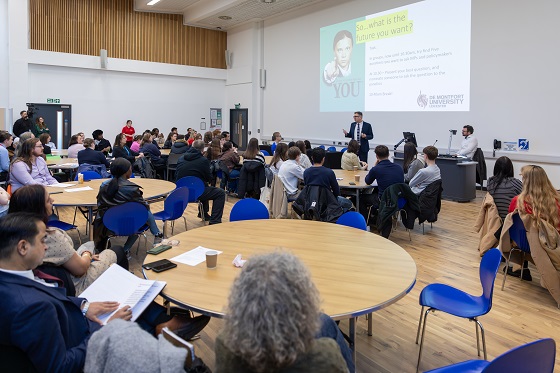
Yet the leaders at COP 26 in the UK and COP 27, held in Saudi Arabia, both failed to achieve significant outcomes for the planet raising concerns of what might be achieved at COP 28. Domestically, green policies have been abandoned and Net Zero targets eased rather than tightened, despite this year’s dramatic weather events. As the next General Election advances, we have brought first time voters together to consider whether they feel politics is failing them and the planet, and if so, what should be done? This week, policymakers, polticians and stakeholders in the climate debate got the chance to hear these concerns from a large group of first time voters (pictured above). They had chance to respond to the young people and directly answer the questions of whether politics, or rather politicians, can fix the planet and whether voting will lead to the actions needed to reduce the impacts of climate change. If anything, this discussion at De Montfort University yesterday, as part of the ongoing COP 28 activity at home and in Dubai, left most impartial observers (like me) feeling that the young people who included DMU undergraduates and A-Level students from Melton Vale Sixth Form College and Rawlins Academy in Leicestershire, had far better questions than the politicians had answers. Regarding that point, rather than target individuals representing various parties across the political spectrum from Conservative to Greens and all in between, the answers felt much more about sticking to party lines than thinking openly about future policy to address audience concerns. The two young climate activists also on the panel – Chay Harwood and Emma de Saram – spoke with much greater clarity about clearing the road for focussed climate action. My sense from the event was that young people’s opinions were split on how effective politicians might be, but suggested the impact of taking part was more about them finding their own voice. Zaynab Mohammed, also from Rawlins, was one of the students who put a question to the panel. She said: “It was an event that was really informative and an education for most of us in the room. It gave me the chance to raise my voice and be heard by prospective MPs and councillors. Climate change is such an important issue to me now. Before this event I did not take it seriously. But now I definitely want my voice to be heard.” Personally, I think that’s the type of impact we should be looking for in a political environment increasingly looking out of touch, out of workable ideas or too allied to the party line. Full coverage of this event can be found here.
100 Ideas for the Planet in the planning…
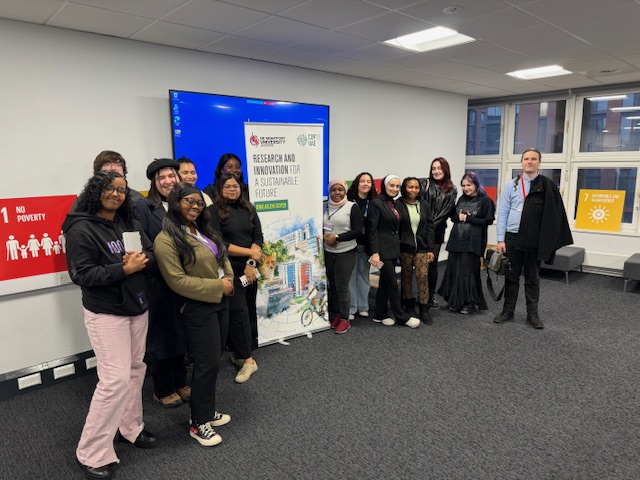
The event with A-Level students, informed some of the thinking and debate in a follow-up activity for DMU scholars led by DMU Politics and International Relations focussed on the global picture. Next year, election fever will grip the planet as global superpowers India and the United States go to the polls to decide their next leaders. Furthermore, Portugal, Pakistan, Croatia and others will also hold elections. The United Kingdom could follow with either an announcement, or an early election in 2024. As international leaders meet for COP 28, the state of politics and its ability to tackle the biggest challenge of our age – Climate Change – is being called into question. DMU Politics and International Relations are being responsive to fellow young people, who often feel marginalised by mainstream politics, who are now suddenly being triggered into action by concerns over the environment and a lack of political action to tackle problems of fossil fuel pollution, damage from plastics and a failure to move at speed towards clean energy. These students are encouraging everyone to have their say, as part of the university’s new Campus Collective on Sustainability, to come up with a manifesto for global leaders that will not only win back the missing votes of young people but also deliver policies that will help protect the planet for years to come. COP 28 in Dubai provides the perfect backdrop to open discussions for Politics for the Planet 2024, engaging young people in elections around the world and giving them a say in the future they want to see. Combining the targets of Sustainable Development Goal (SDG) 13 (Climate Action) and SDG 16 (Peace, Justice and Strong Institutions). The first group of students (Pictured) held the first scoping session of this project after the visit from A-Level students. They have decided to follow an existing model of engagement which has seen new policies created and shared in the ‘100 ideas for…’ series. Previous projects have included 100 Ideas to Change Leicester, 100 Ideas to change Britain 100 Ideas to Change Europe. This time the students have a working title of 100 Ideas for the Planet. Those who took part in the consultation on themes agreed (without prompting from staff at the DMU UNAI SDG HUB) that the 17 UN Sustainable Development Goals should provide the framework for developing their 100 ideas. The students will meet monthly to plan the project and devise the strategy on how they gather data to support shaping the policy suggestions. Anyone withing to get involved should email dmusdg16@dmu.ac.uk
 Sustainability Field Notes
Leave a comment