
Last week I was one of three researchers who were selected to present their work to a high-level committee to try to convince them that our work was worthy of a future Government inquiry. My pitch to a selection of members of the Environmental Audit Committee, including Chris Skidmore MP, Caroline Lucas MP, Clive Lewis and John McNally MP argued for an investigation into whether support amateur grassroots sports clubs wanting to reduce their environmental impacts is adequate. This was my address to the panel of cross-party MPs, which I had to deliver in three minutes, which a large clock ticking above me to set the scene. To add to the pressure of the occasion, there was an audience of about 100 other MPs, experts and specialists who have been part of or advised the Environmental Audit Committee over the past 25 years.
Our pitches, which were a Dragon’s Den-style format in an attempt to bring academia closer to public policy making, followed a speech by former Prime Minister Theresa May which had set a scene for collaboration between research, business and policy with a keynote speech on the need to work together to preserve the planet for future generations.
My recommendation was an impact of the ongoing Net Zero Football research project being delivered by a network of DMU researchers and local and international partners via DMU’s United Nations Academic Impact Hub for Sustainable Development Goal Hub for SDG16 (Peace, Justice and Strong Institutions).
So far, the project has used frameworks within SDG 16 and SDG 13 (Climate Action) to design activities that give young people a greater say in how local sports teams can be more sustainable.
This is my (unedited) speech to the committee:
“Today I’d like to raise the raise the issue of the role of grassroots sports clubs in tackling climate change as part of the Government’s long-term net zero strategies.
I have been working with a network of amateur inner-city football teams (including Leicester Nirvana, Vicky Park Queens and others), in areas of deprivation or significant social challenges, to develop new research towards helping them to achieve their environmental ambitions.
If we are to achieve Net Zero by 2050, or sooner, it will require people from all walks of life to work together to create, deliver and use new innovations for a sustainable future. Grassroots sports clubs are one overlooked area of society which has yet to be harnessed in the climate change debate.
In my 12-months of working with men’s, women’s and children’s amateur football clubs, I am yet to see a single football kicked. But I have seen how an army of volunteers provide an incredible service to their communities, inspired by the love of their sport, including everything from mental health support to educational opportunities.
These clubs, give so much to the good of the social fabric of their estates and they are asking how they can work towards tackling climate change and playing their part in creating a sustainable future. Keeping football as the example, more than 14 million people play at community levels each year and grassroots participation in England contributes £10.16bn back to society per annum.
Football alone receives £240m from Sports England, an arm’s length body of Government, for new facilities and projects each year. Several environmental initiatives to engage grassroots sports have been launched in recent years but are yet to take hold in the same way other initiatives like the brilliant Kick It Out and This Girl Can campaigns have.
This highly respected committee has a remit is to investigate the extent to which the policies and programmes of Government and its public bodies contribute to sustainable development and environmental protection targets.
So today I am arguing for the committee to consider a two-fold opportunity.
The first is to investigate whether support for amateur grassroots sports clubs wanting to reduce their carbon footprints and environmental impacts is adequate.
The second is to assess the potential of a national network of community sports clubs to form a social movement towards Net Zero with a new campaign promoting a sustainability toolkit to get teams started.”
While I emphasised the UK potential of the project, based on my experiences with Leicester Nirvana and others, I was later able to explain how it links closely to the UN’s Football for the Goals campaign and has attracted amateur clubs and university partners from around the world to participate including Germany, Spain, Malaysia, The Gambia, The Republic of Benin and others.
The presentation to the Environment Audit Committee was part of a 25th Anniversary event, Environmental Scrutiny Towards 2050, held at Imperial College London on Wednesday February 22 and I was delighted to have been selected and meet some interesting contacts in the networking event afterwards.
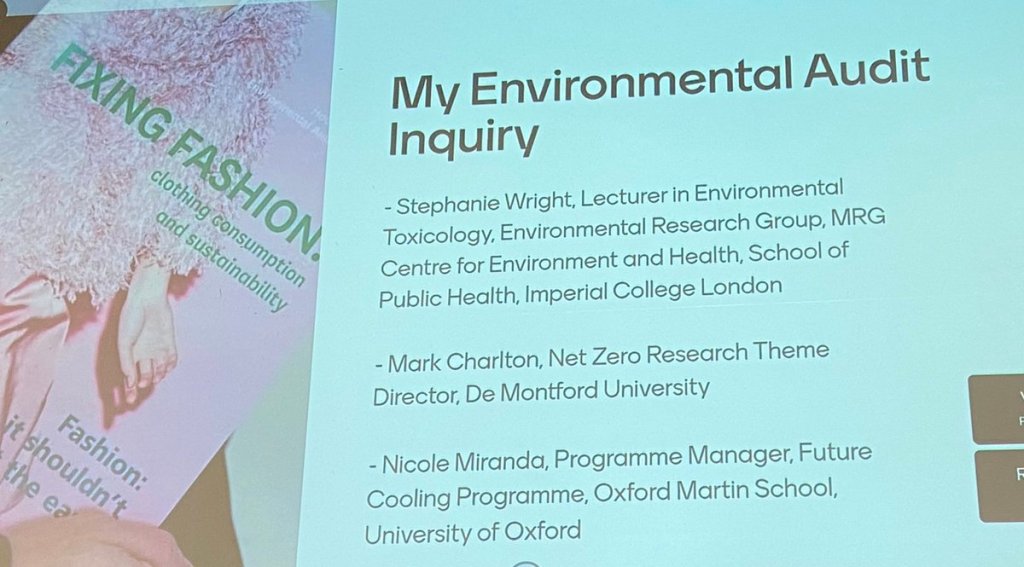
The two other researchers who took part were: Dr Stephanie Wright of Imperial College who made a case for an inquiry into impacts of microplastics on the environment, especially marine environments and food chains and Dr Nicola Miranda from the University of Oxford calling for an inquiry into the role cooling can play in delivering the Government’s Energy Security and Building and Heat Strategies. Both gave outstanding presentations. We find out if our proposals will be taken forward later this year.
There are lots of opportunities to get involved in the Net Zero Football Project. Students and staff and football clubs wishing to find out more can email me via: mcharlton@dmu.ac.uk
 Sustainability Field Notes
Leave a comment